Publication of CHARTER’s 12 Recommendations: A Roadmap for a Thriving Heritage Sector
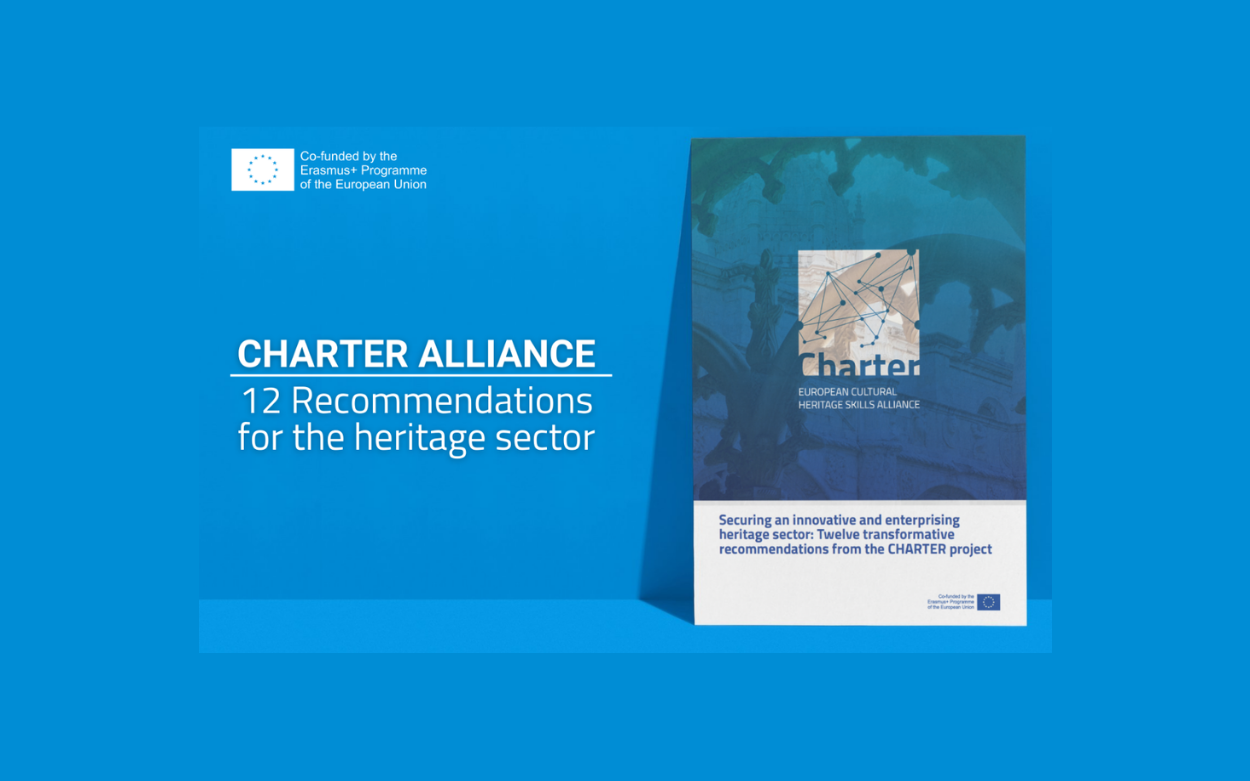
ICOMOS is proud to share CHARTER’s 12 concrete recommendations to strengthen the heritage sector by addressing key gaps in education, training, and labour market needs. These targeted actions aim to ensure sustainability, inclusivity, and innovation while positioning cultural heritage as a driver of social, economic, and environmental progress.
The 12 CHARTER Alliance Project recommendations were developed through extensive research, consultations, and collaboration with regional, national, and European stakeholders since 2021. Work Package 2 of the project, co-led by ECCO and ICOMOS (represented mainly by Bosse Lagerqvist, ICOMOS Sweden and CIF), provided a critical foundation for the work that led to the recommendations by mapping the cultural heritage ecosystem and identifying key competences, occupational profiles, and skills gaps to ensure the recommendations were evidence-based and forward-looking.
The recommendations were developed and refined through a series of key events in 2024.
- Paris Conference (March 2024): Co-organised in partnership with ICOMOS, Labex Industries Culturelles & Création Artistique (Université Sorbonne Paris Nord) and Institut National du Patrimoine, this two-day event served as the first public event where the project recommendations’ main thematic axes were introduced and discussed with a selected group of cultural heritage stakeholders coming from all around Europe. ICOMOS was represented by its President, Teresa Patrício, Bosse Lagerqvist, ICOMOS Lead Scientific Coordinator for CHARTER, Célia Martinez Yanez, Vice President of ISC Cultural Tourism, and Gaia Jungeblodt, Director of the ICOMOS International Secretariat.
- Brussels Second Policy Round Table (April 2024): This session, which Bosse Lagerqvist participated in, presented an improved version of the draft recommendations to policymakers, focusing on the stakeholders affected by them, and the methodology employed for drafting.
- Final Conference in Barcelona (November 2024): Marking the culmination of four years of collaboration, the final conference presented the finalised recommendations alongside three thematic booklets. Its dialogues focused on addressing the re-skilling of heritage professionals, addressing gaps in occupational profiles and the heritage workforce market, in light of the CHARTER’s insights. ICOMOS was represented through Bosse Lagervist, Xavier Casanovas i Boixereu, Board of ICOMOS-Spain and Estefania Macchi, representing the President of ICOMOS CIF.
Each recommendation is supported by specific implementation actions, clearly categorised by the relevant stakeholders. Additionally, the document provides detailed sections tailored for recommendations involving the European Union, Member States and Regional Authorities, Education and Training providers, and Heritage institutions and employers, ensuring a comprehensive and actionable roadmap for the sector.
CHARTER's 12 Recommendations
1) Establish skills strategies for the heritage sector for a systemic change
Encourage coordinated skills strategies at the EU, national, and regional levels to align education and labour market demands, ensuring heritage’s role in achieving societal and environmental goals.
2) Counteract the loss of heritage skills
Combat the loss of traditional heritage skills caused by disrupted generational transfers, shrinking markets, and precarious employment. Emphasise their relevance for addressing modern challenges like sustainability and climate resilience.
3) Complement core heritage skills with transversal skills to foster inter- and trans-disciplinarity
Equip heritage professionals with communication, digital, entrepreneurial, and ethical skills alongside core competencies in preservation and governance to navigate evolving challenges and interdisciplinary roles.
4) Offer future-focused education and training
CHARTER identifies eight pathways for adapting or developing curricula: community engagement, sustainability in built heritage, heritage crafts, new heritage conservation, digital heritage, participatory leadership, heritage policy design, and international relations. These pathways address current and future sector demands.
5) Promote a Lifelong Learning area for the heritage sector
Encourage continuing education (CET) to upskill and reskill professionals in areas like digital content creation, conservation, and management, ensuring flexibility to adapt to emerging needs such as AI and digital outreach.
6) Foster the recognition of non-formal and informal prior learning
Expand recognition of skills gained through non-formal and informal methods, such as on-the-job training and traditional crafts, using tools like micro-credentials and validation processes to improve mobility and career access.
7) Ensure work-based learning for professional development and early-career progression
Enhance access to internships and traineeships by improving coordination, offering fair remuneration, and ensuring better integration into education programs to bridge gaps between training and the workplace.
8) Strengthen quality assurance in heritage education and training
Standardise quality assurance in vocational (VET) and continuing education (CET) to ensure consistent standards across the EU, particularly for work-based learning, which is vital for heritage professionals.
9) Strive towards a viable, diverse heritage workforce
Address workforce precarity by improving job stability, promoting gender equality, and increasing representation of disadvantaged groups to foster diversity and resilience in the heritage sector
10) Foster professional recognition and facilitate mobility
Harmonise standards and improve recognition of qualifications to support the mobility of heritage professionals across the EU, addressing gaps in tools like ESCO and improving alignment with national frameworks.
11) Develop and use robust socio-economic indicators for evidence-based policies
Improve data collection and monitoring using updated methodologies and taxonomies to ensure reliable statistics that reflect the sector’s dimensions and inform effective policymaking.
12) Develop intersectoral cross-pollination of heritage knowledge
Recognise and enhance heritage’s intersection with other sectors like tourism, sustainability, and urban planning, while improving procurement standards to include heritage-related activities and attract skilled professionals.