ICOMOS Heritage Alert - Indian Institute of Management Ahmedabad (IIMA) Old Campus
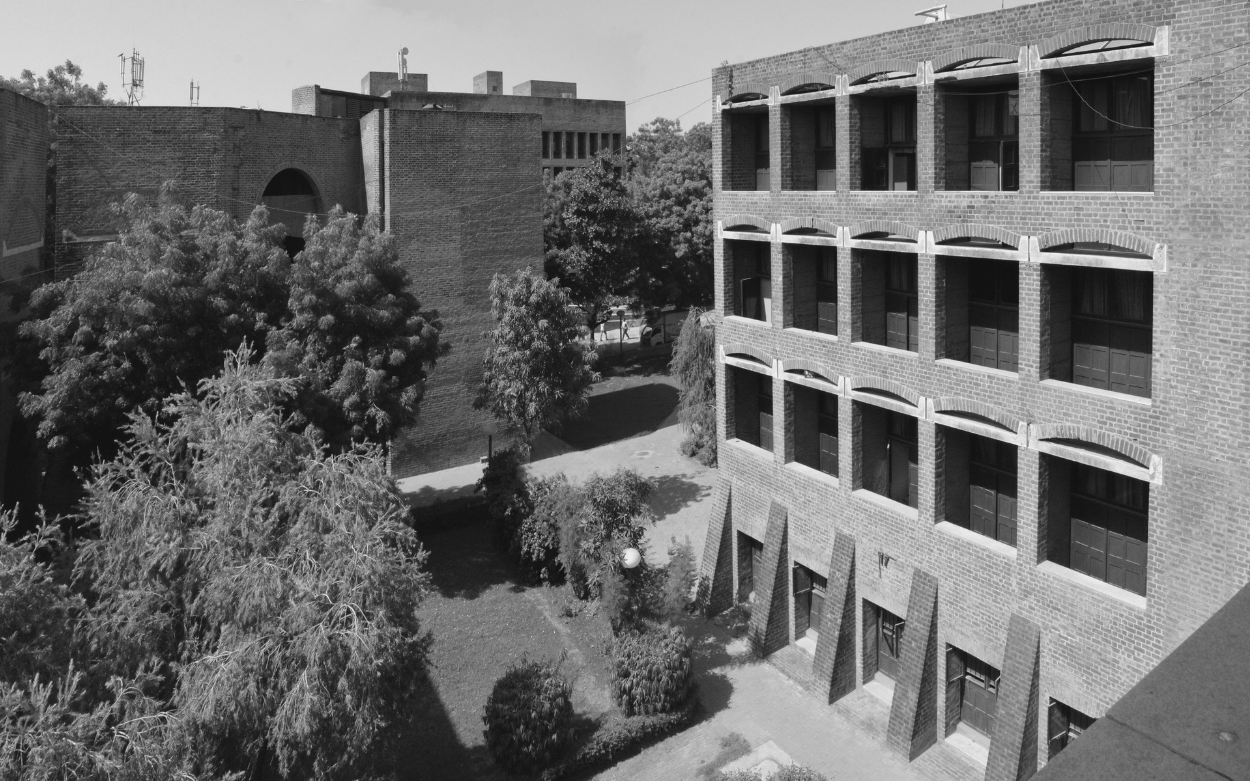
ICOMOS is issuing a worldwide Heritage Alert, our most consequential expressional of concern, to amplify awareness of the threat to the Indian Institute of Management Ahmedabad (IIMA) Old Campus and draw urgent attention to the eminent risk of loss of the internationally significant buildings that make up the cultural landscape designed by Louis I. Kahn with his team of Indian architects, landscape architects and engineers.
OBJECTIVE OF THE HERITAGE ALERT
This Heritage Alert is being issued to gather international support for the protection and comprehensive conservation of the iconic ‘Indian Institute of Management-Ahmedabad’ (IIM-A) located at Ahmedabad, India. The IIM-A campus and its individual components were designed during 1962-1974 by one of the most influential architects of the twentieth century, Louis I Kahn, who worked in close collaboration with two internationally celebrated Indian architects, Balkrishna V Doshi and Anant D Raje as well as Indian landscape architects and engineers.
INTRODUCING IIM-A
The Indian Institute of Management-Ahmedabad (IIM-A) was established as part of India’s post-independence endeavours at strengthening and modernising its social, economic and cultural infrastructure. The founding of the institute and the philosophy of its being were results of a global collaboration between two Ahmedabad- visionaries, the Governments of India and its Gujarat State, the Ford Foundation and the Harvard Business School. Besides the hot-arid climate of Ahmedabad, the other contextual factors that were to impact the project’s design and form include the economic and technological constraints prevalent in India of the 1960s and India’s ancient building traditions.
Spread over 65 acres, the Indian Institute of Management at Ahmedabad was conceived as a self-sufficient, residential campus containing the academic core (classrooms, faculty rooms and a library), a dining hall for students and faculty, dormitories for 300 students, and 110 housing units of various categories for the faculty and staff. Louis Kahn’s personal pre-occupation with notions of ‘extended learning’ and constant ‘meetings and interactions’ pervades the design of the layout as well as all individual buildings. The campus, therefore, became a harmonious single entity in which the carefully crafted built volumes, the open areas and the interior spaces come together as a highly aesthetic dynamic order of spatial and structural systems.
The IIM-A is also known for Kahn’s highly inventive manner of deploying the traditional local brick and generating a new vocabulary that could re-interpret tradition through technological sophistication. “These buildings stretched the bounds of conventional masonry technology while they re-affirmed the timeless power of massive brick construction. Kahn’s experiments helped to promote brick to an almost exalted status in the vocabulary of the Indian architect.” The campus is yet another testimony to Louis Kahn’s distinctive play of controlled light, achieving a sense of timelessness and spirituality beyond mere human existence.
CULTURAL AND ARCHITECTURAL SIGNIFICANCE
In addition to symbolising the local and national aspirations for modernisation and progress, the Indian Institute of Management-Ahmedabad is significant for being a part of the mid-twentieth century narrative of de-colonisation in various parts of the world, the emergence of nation states, the consequent changing approaches to governance and widespread progressive efforts. Its cultural value is also a consequence of the close and unusual collaboration between its local, national and international stakeholders, both during the conception and the realisation of its unique education philosophy. Seen in terms of its highly creative architectural form, as well as the innovative construction technology, IIM-A can be considered as a masterpiece of human creative genius, recognised globally as an icon of 20th century architecture, a landmark in the global and South Asian narratives of institutional ensembles.
IIM-A’s international importance is comparable, for example, to ‘Thomas Jefferson’s University of Virginia Academic Village’ (inscribed in the World Heritage List in 1987) and, the ‘Universidad Nacional Autonoma de Mexico’ in Mexico City (inscribed in 2007).
THE THREAT
In December 2020, the IIM-A authorities floated a tender inviting ‘Expression of Interest’ for design of new students’ housing on the land parcel currently occupied by 14 of the original 18 dormitories. Following widespread protests from various quarters around the world, the authorities withdrew the tender document to hold further deliberations. Though the threat to the dormitory units has been shelved – perhaps, temporarily, the original historic fabric of Louis Kahn’s IIM-A continues to be under risk of irreversible alterations, including potential demolition of several Kahn and Raje designed structures and construction of ill-considered multi-storeyed blocks that would adversely impact the unique hierarchical spatial order, functional linkages and visual harmony for which the campus is valued. These alterations have been proposed as part of the ongoing “25-year Master Plan” by HCP Design Planning & Management Pvt. Ltd., IIM-A’s appointed architects.
Currently, IIM-A does not figure in the list of heritage structures issued by Ahmedabad Municipal Corporation, and does not enjoy any legal heritage protection – just as all other post- independence (post-1947) buildings of cultural significance. This Alert is intended to initiate the preparation of a Comprehensive Conservation Management Plan for the campus, where the significance of the campus as a single entity and each constituent building can be assessed and recommendations made accordingly. There is a need to revisit the basis of HCP’s “25-year Master Plan” and adopt a more conservation-sensitive approach to development, including provision of legal heritage protection for the campus.
RECOMMENDED ACTION AND DESIRED OUTCOME
Keeping in view the desired protection and conservation of IIM-A’s original design, ICOMOS and the International Scientific Committee on Twentieth Century Heritage recommend that the Governing Council of IIM-A, as the steward of the unique ‘Kahn Old Campus’, should initiate action to:
- Undertake a properly structured and staffed ‘Comprehensive Conservation Management Plan (CCMP) to address the significance, authenticity and integrity of the Old Campus, define proper treatment and use and, formulate a strategy for implementation of the CCMP’s recommendations.
- Suspend all action regarding changes proposed to the Old Campus, including demolition and new constructions in the “25-year Master Plan” by HCP Design Planning & Management Pvt. Ltd., until the ‘Comprehensive Conservation Management Plan’ (CCMP), including an exercise of ‘Heritage Impact Assessment has been undertaken.
- Initiate immediate action for minimum maintenance of the all historically significant buildings in the IIMA Old Campus until their appropriate restoration is achieved.