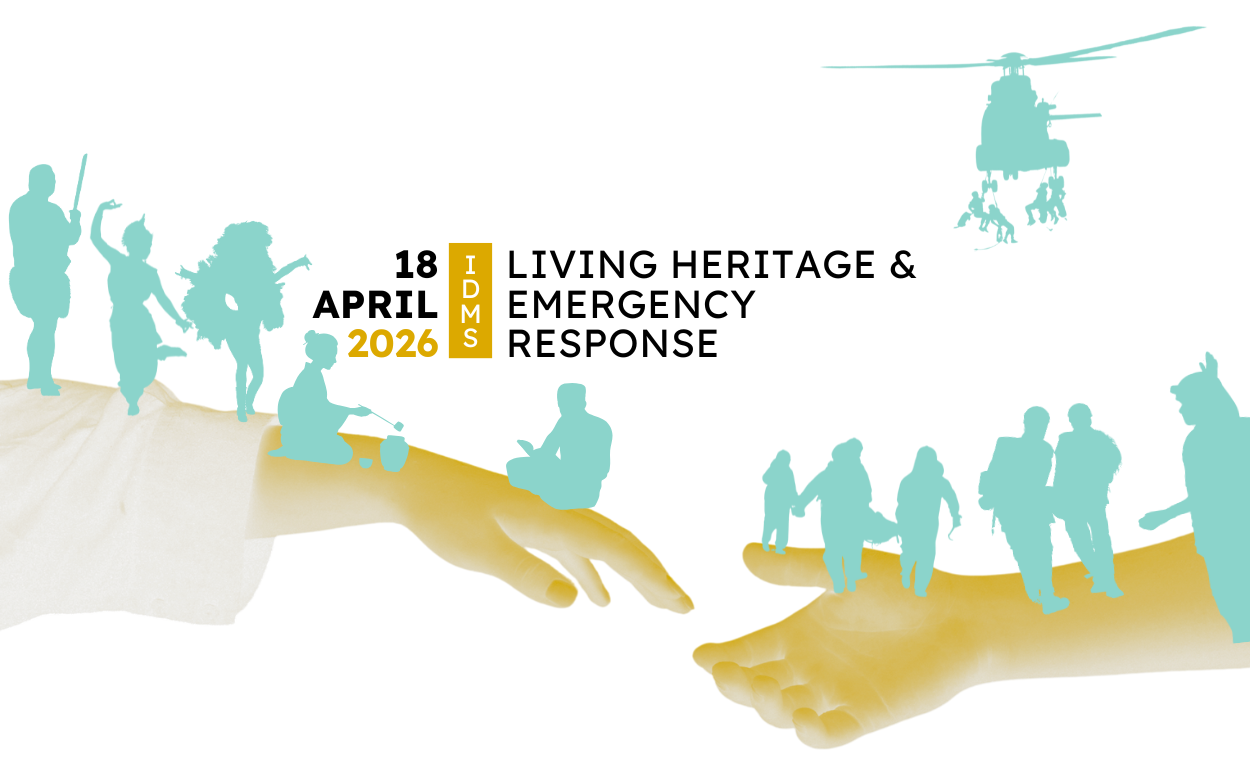
International Day for Monuments and Sites 2026 – Emergency Response for Living Heritage in contexts of Conflicts and Disasters
Related events
See all eventsCelebrated each year on 18 April, the ICOMOS International Day for Monuments and Sites (IDMS), provides heritage enthusiasts, heritage professionals and ICOMOS members with the opportunity to shine a spotlight on the shared responsibility of safeguarding our heritage. This year, IDMS focuses on bringing visibility to the work undertaken to conserve and protect the world’s culturally significant “Living Heritage” – increasingly at risk from accelerating disasters and conflicts unfolding in complex, multi-hazard contexts.
What is “Living Heritage”?
UNESCO defines “Living Heritage” as the “oral traditions, performing arts, social practices, rituals and festive events, knowledge and practices concerning nature and the universe, and the knowledge and skills related to craftsmanship”. In its work, ICOMOS understands “Living Heritage” to encompass all dimensions of cultural heritage – tangible, intangible and natural*.
How can heritage professionals, communities, institutions, and decision-makers at all levels better respond to these disasters and conflicts affecting living heritage? What role can they collectively play, and what do they need to be effective in that work?
Context behind the 2026 IDMS theme
The ICOMOS Triennial Scientific Plan 2024-2027 frames its work around the theme “Disaster and Conflict Resilient Heritage – Preparedness, Response and Recovery”. After focusing on Preparedness in 2025, ICOMOS turns its attention in 2026 to Emergency Response in the conservation of heritage affected by disasters and conflicts.
Emergency Response is not an isolated intervention, but an integral part of the broader disaster risk management cycle – one that ensures emergency actions support resilience without predetermining long-term outcomes. This approach encompasses a wide range of initiatives, from advocacy and analysis to on-the-ground action in prevention, mitigation, preparedness, emergency response, and recovery. Together, these efforts seek to safeguard “Living Heritage” and the communities that sustain it in times of crisis.
Link with ICOMOS doctrine and statutory events
Activities under this theme also contribute to the ongoing development and implementation of ICOMOS doctrinal texts, including the forthcoming ‘Charter on Preparedness for Emergency Response to Cultural Heritage in Disasters and Conflicts’.
The 2026 IDMS activities will conclude with this year’s ICOMOS General Assembly Scientific Symposium in Sarawak, Malaysia (17-24 October 2026) whose theme is LIVING HERITAGE: RESPECT – ENHANCE – ACCEPT – PARTNERSHIP.
How do I get involved in IDMS?
All are encouraged to share their experiences, events, publications and outcomes of discussions around resilient living heritage in the context of conflict and disaster response.
You too can help raise awareness and assist in the identification of the wide range of scientific and traditional practices worldwide that contribute to the protection of heritage in extreme and extraordinary circumstances.
Heritage enthusiasts, heritage professionals and ICOMOS members are welcome to:
• consider the potential impacts on heritage resources by conflict and disaster;
• examine what resilience looks like in the face of those impacts; and
• what they can do to RESPOND, within their mandates, capacities and ethical frameworks, from their national and scientific perspectives.
Some of the activities might include workshops/seminars, publications and training in:
• emergency monitoring;
• activating safety and security protocol needs assessments;
• damage assessments;
• people-centred assessments balancing immediate humanitarian needs and heritage salvage during disasters and conflicts;
ICOMOS calls upon its Committees to organise and collaborate on events on the theme of EMERGENCY RESPONSE FOR LIVING HERITAGE IN CONTEXTS OF CONFLICTS AND DISASTERS.
Share information on your IDMS activities with ICOMOS by writing to: communication[at]icomos.org
Possible initiatives
Potential formats for participation can include, but are not limited to:
• 1 to 2 minutes (maximum) video submissions from a ICOMOS National Committees, International Scientific Committees, International Working Groups and individual members, showcasing local and regional approaches to caring for “Living Heritage” in the face of conflicts and disasters. Participants may share the videos with communication[at]icomos.org. Make sure to include descriptions, quotes or facts to accompany any video, and credits.
• Photographic submissions with credits and captions to explain current conservation practice approaches, changing narratives and goals for the future of cultural heritage, to adapt to the urgent demands of EMERGENCY RESPONSE in the face of conflict and disaster. In all cases, please make sure that you retain the rights to any image you share and provide full credit.
• Organise virtual roundtables, webinars, and workshops to address gaps in cultural heritage theory and conservation practice when RESPONDING to conflicts or disasters, inviting government agencies, industries and other stakeholders to join the discussion.
Events, activities and other inputs may be reviewed and shared on the ICOMOS website, social media platforms and the annual report of ICOMOS.
Active participation by members and committees on the International Day for Monuments and Sites (IDMS) is an opportunity to demonstrate the contemporary relevance of ICOMOS and the valuable work its members conduct.
Relevant hashtags: #18April #ICOMOS #IDMS2026 #icomosIDMS2026
Tag ICOMOS in your social media posts!
*Natural heritage refers to a region’s biodiversity, geodiversity, and natural features—such as landscapes, seascapes, waterways, woodlands, bogs, uplands, habitats, and native wildlife, including plants, insects, birds, and animals (Source: An Comhairle Oidhreachta = The Heritage Council. _What is Heritage?_ Kilkenny (Ireland), s.d. URL)